

Ahead of the Reserve Bank of India's (RBI's) monetary policy review in the first week of December, major public sector non-banking financial companies (NBFCs) - the National Bank for Agriculture and Rural Development (Nabard), Small Industries Development Bank of India (Sidbi), Power Finance Corporation (PFC), and Indian Railway Finance Corporation (IRFC) - plan to raise up to Rs 24,000 crore together through bond issuancesk.

Wholesale price inflation (WPI) softened to 0.13 per cent in September on easing in prices of food articles and manufactured items, government data showed on Tuesday. WPI-based inflation was 0.52 per cent in August and 1.91 per cent in September last year.

Despite gross domestic product (GDP) growth being lower-than-expected for the July-September quarter, the six-member Monetary Policy Committee (MPC) may not cut the policy repo rate in the review meeting scheduled for next week due to high inflation in October, according to experts. "Consumer Price Index (CPI) inflation breaching the upper limit of the RBI's tolerance band in October (6.2 per cent year-on-year) is not a favourable backdrop for the MPC to commence the easing cycle, even as the growth outcome disappointed the MPC's expectations," said Shreya Sodhani, regional economist at Barclays, who expects the policy repo rate to be kept unchanged in the December meeting.
In his first monetary policy review since taking office on September 4, RBI Governor Raghuram Rajan increased the repo rate by 25 basis points to 7.50 per cent.

Among the 30 Sensex firms, Asian Paints, Infosys, JSW Steel, UltraTech Cement, Power Grid, Larsen & Toubro, HCL Technologies and Tata Steel were the biggest laggards. Tata Motors, HDFC Bank, Bharti Airtel, ITC, IndusInd Bank and Axis Bank were the gainers.
Further hike will depend on the RBI's assessment

The US Fed rate cut of 50 basis points is unlikely to have any significant impact on foreign inflows into India, Economic Affairs Secretary Ajay Seth said on Thursday. He said the US Federal Reserve has done what it assesses is good for the largest economy in the world, but the RBI will take a decision on interest rate cut keeping the Indian economy in mind. "It is a positive for the global economy, including the Indian economy. "It is a 50 basis points cut from a high level.

The monetary authority said it was worried on three fronts with regard to inflation as well as the economy.

Retail inflation slipped to 1.54 per cent in September from 2.07 per cent in the preceding month mainly due to subdued prices of food items, including vegetables and pulses, according to government data released on Monday. The consumer price index (CPI) based inflation was 5.49 per cent in September 2024.

RBI has held its short-term lending (repo) rates unchanged at eight per cent since April 2012.

Reserve Bank of India (RBI) Governor Shaktikanta Das has said the decision on interest rate moderation will be based on long-term inflation trajectory and not monthly data. The Monetary Policy Committee (MPC) headed by the RBI Governor is scheduled to meet between October 7 and 9 and take call on interest rate. The RBI kept the repo rate unchanged at 6.5 per cent for the ninth time in a row amid risks from higher food inflation.
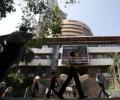
The wider NSE Nifty too ended 21.55 points, or 0.21 per cent down at 10,476.70.

The wholesale price inflation rose to 1.84 per cent in September as food items, especially vegetables, turned costlier, as per the government data released on Monday. The wholesale price index (WPI)-based inflation was 1.31 per cent in August. It was (-)0.07 per cent in September last year.

For the time being, the RBI is done with the cuts. A cut in October, which many are still predicting, is not certain. Of course, if growth nosedives, the script will be different, expects Tamal Bandyopadhyay.
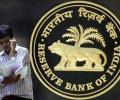
The Reserve Bank of India (RBI) on Friday kept key repo rate unchanged at 4 per cent in view of rising inflation and faint signs of economic growth amid gradual lifting of coronavirus (COVID-19) lockdown. The central bank's newly-constituted monetary policy committee (MPC) began its three-day meeting on October 7 and maintained the stance as accommodative. It also kept the reverse repo rate unchanged at 3.35 per cent.
India's central bank withdraws cap of Rs 3,000 crore (Rs 30 billion) on daily reverse repo (overnight borrowing) transaction from August 6.

From the 30-share pack, Adani Port, Bharti Airtel, Asian Paints, IndusInd Bank, Bajaj Finserv, Reliance Industries, Infosys, UltraTech Cement, HDFC Bank, HCL Technologies and ICICI Bank were among the laggards. Tata Motors, Axis Bank, Maruti, Larsen & Toubro, ITC and Tata Steel were among the gainers.
RBI sees marginal improvement in economic growth to 5-6%.

The NSE Nifty, after shuttling between 10,331.80 and 10,227.45, finally settled 196.75 points, or 1.94 points higher at 10,325.15.
Kotak Mahindra Bank was the biggest loser in the Sensex pack, sliding 2.68 per cent, followed by Tech Mahindra, Mahindra & Mahindra, Axis Bank, Hindustan Unilever, Tata Motors, Tata Consultancy Services, Bajaj Finserv, Bajaj Finance, Nestle and Titan. In contrast, NTPC, Power Grid, Larsen & Toubro, HDFC, Reliance and HDFC Bank were the gainers.
Part of a focus on retail advances, as corporate demand remains subdued; could reverse if RBI raises repo next month

The lender, however, is not likely to reduce its base rate to which all loan rates are linked.
Nearly all the 43 economists surveyed over the past week expect the RBI to leave its key repo rate on hold at 8 per cent.

The Reserve Bank's rate-setting panel began its three-day deliberations on Monday to decide the next monetary policy amid expectations that the central bank will maintain status quo on the benchmark interest rate in the backdrop of global scare due to the new coronavirus variant Omicron. Reserve Bank Governor Shaktikanta Das headed six-member Monetary Policy Committee (MPC) is scheduled to announce the policy resolution on Wednesday. If the RBI maintains status quo in policy rates on Wednesday, it would be the ninth consecutive time since the rate remains unchanged.
The repo rate has been unchanged since January, when the RBI increased it by a quarter percentage point.
Bankers do not expect any major changes in key interest rates by the Reserve Bank in its quarterly review of the monetary policy on October 31.

Ignoring the rate cut demand of India Inc, RBI in its first quarter monetary policy review kept the short-term lending (repo) rate, at which banks borrow from RBI, unchanged at 8 per cent.
The Reserve Bank of India on Wednesday decided to keep the policy rate unchanged for the tenth time in a row but changed its stance to 'neutral' that may lead to a cut in the forthcoming policies. RBI maintained status quo despite the US Federal Reserve lowering the benchmark rates by 50 basis points last month.

It believes that RBI will continue with liquidity infusion through CRR cuts and open market operations. Rate cut may happen only in January

The rupee continued to face pressure in the first half of the current financial year (FY26), hitting fresh lows against the dollar, due to strengthening of the greenback, rising crude oil prices, and foreign outflows. Rupee has depreciated by 3.7 per cent so far in the current financial year after starting at a good note in April.

Rajan said the central bank has used up all its "space available" to cut interest rates

RBI unsure whether to cut rates or not in its next monetary policy.

Weakness in the rupee against the US dollar also weighed on domestic stocks. The local unit fell 11 paise to 70.60 against the US dollar intra-day.

Reliance Industries was the top gainer in the Sensex pack, rallying nearly 4 per cent, followed by Infosys, Tech Mahindra, HCL Tech, TCS and L&T.

In its scheme of things, tackling inflation now comes ahead of ensuring growth in the world's sixth largest economy, points out Tamal Bandyopadhyay.
.jpg)
Industry's demand for a reduction in the repo rate, currently 8 per cent, has gained momentum after wholesale and retail inflation eased in February.

The Reserve Bank is likely to maintain status-quo on the key interest rates for the third time in a row in its upcoming bi-monthly policy review despite the US Federal Reserve and the European Central Bank hiking benchmark rates, as domestic inflation is within the RBI's comfort zone, say experts. The borrowing cost which started rising in May last year has stabilised with RBI keeping the repo rate unchanged at 6.5 per cent since February when it was raised from 6.25 per cent. In the previous two bi-monthly policy reviews in April and June the benchmark rate was retained.

Wholesale price inflation rose to a 4-month high of 2.36 per cent in October as prices of food items, especially vegetables, and manufactured goods turned dearer, as per the government data released on Thursday. The wholesale price index (WPI) based inflation was 1.84 per cent in September 2024. It was (-) 0.26 per cent in October, last year.
